

Golf practice time is precious, and golf isn’t exactly like riding a bike. Spend any meaningful time away from the game the rust is bound to set in. Sure, you can still produce something akin to a golf swing, but your feel for the game can and will erode over time. That makes it all the more maddening when you do invest the time in golf practice but don’t benefit from it.
What’s wrong with your golf practice then? How is it that we can invest time and effort but not see any real gains in our abilities, or any discernible improvements on the golf course? Chances are, your golf practice is lacking. Here’s a three ways your golf practice might be coming up short of your goal of better abilities and lower scores.
You’re Practicing the Wrong Things

Watch the average golfer at the driving range for a golf practice session and you’ll likely see a familiar script. Perhaps a few warm-up wedges get struck, but eventually they’ll settle in to a 7 or 8 iron and begin working on that one move they’re convinced they need to ingrain to get their game over the hump. Perhaps our golfer will graduate to hitting a few drivers, but the bulk of the session is spent firing away with that same mid-iron or short-iron, burning in that magic feel they just know they need to ingrain.
So what’s wrong with this picture? A whole lot. The first problem: has our golfer actually spent the time to figure out where they are dropping shots? Say 7 iron is his 150 yard club, meaning he just spent ten bucks and an hour working on his approach game from 150. If he’s struggling from that range, then it makes sense to spend some time in that part of the bag, but chances are our golfer is missing greens from all over the place.
Our golfer needs to track and analyze his Strokes Gained data, and let that information determine where he devotes his energies. It’s not enough to say “I need to hit more greens.” A golfer has to understand at what range he’s struggling the most, because that’s the most fertile ground for rapid improvements. Our golfer might even learn it’s not his ball-striking but his putting that needs more attention. Regardless, we all have limits on how much time we can devote to golf practice. Use Arccos, Shot Scope, or any number of phone apps to track and use your Strokes Gained data if you’re really serious about improving.
Golf Practice: Block vs Random
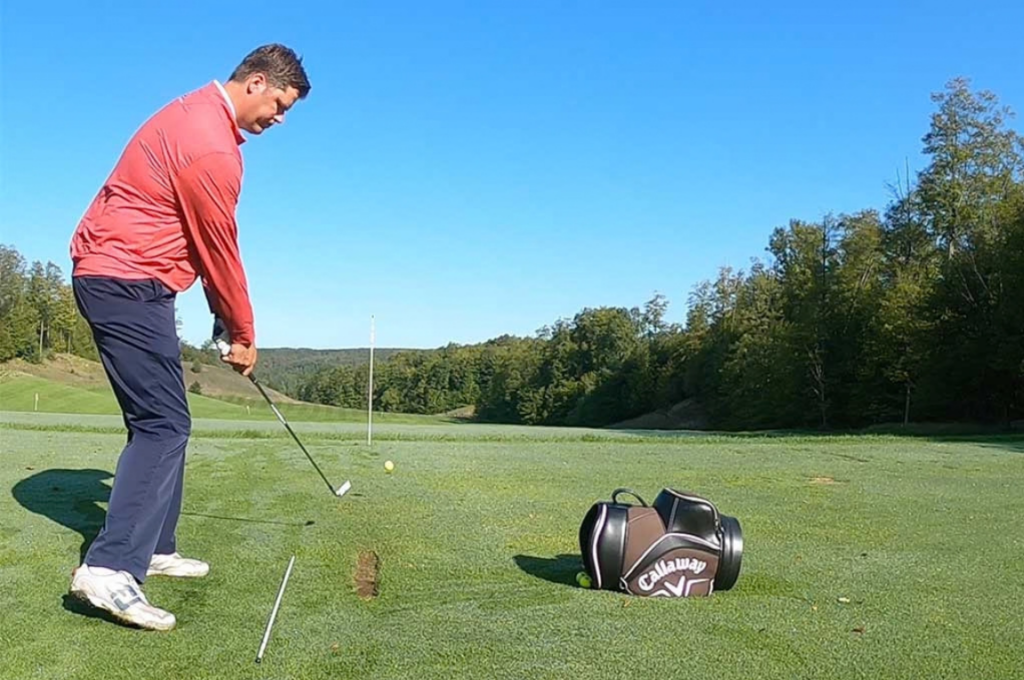
Once you gather some data and figure out what you should be practicing, the next question is how. No, not how much time, or how many reps. There are effective ways to learn or improve a new skill, and endless repetition isn’t one of them. Suppose our golfer got it right and is justified in focusing on his ball-striking from 150-175 yards in particular. Endless continuous repetitions of that 7 iron aren’t the answer. That’s called block practice, and despite what you may have heard about “muscle memory” and “10,000 hours to mastery,” it’s really not very effective in making long-term gains.
3-5 reps of the same shot with the same club at the same distance is about the max you should be attempting. From there, switch clubs, switch targets, and challenge yourself with random practice. If your stock-in-trade is a little fade, put more fade on a few shots. Next, draw a few, then draw it even more. Motor learning research is clear: random golf practice wherein you constantly change the variables and your intent will get you better faster. You WILL improve more, and quicker, through random practice. And, your golf practice will be far more consistent with how the game is actually played.
Your Swing Isn’t the Problem
Sometimes it’s not the swing. You may in fact have a great swing and some solid ball-striking chops. If you’re able to take that ball-striking prowess from the range to the course, but you’re still not seeing lower scores, there’s likely another culprit. You may be making bad decisions once you’re out there.
Bad course management can kill a good round just as quickly as a few mis-hits. Maybe you’re not taking enough club on front pins, or you’re selecting overly aggressive targets altogether. Perhaps you’re too aggressive off the tee, or maybe you’re not aggressive enough and leaving yourself longer more difficult approaches. There are a host of possible chronic strategic errors that could be keeping you from the lower scores you’re capable of. The cure: again, know your Strokes Gained data and see where you’re dropping shots, and consider a course management program like DECADE to help you learn how to score.
Poor decisions are a common symptom of a poor mental game, another possible culprit behind your sub-standard scoring. If you want to bring your scores down, practicing the physical aspects of the game is really only part of the equation. The ability to play to your fullest potential comes from having things squared away between the ears as well. That takes mental training. Yes, that’s right, you can train the mental game. Learning to meditate is a great place to start. From there, you can learn the proper relationship with your thoughts you need to focus on the task of playing golf.
If you’re toiling away on the range and the practice area but the results aren’t showing up on the scorecard, take the time to make sure you’re practicing the right things. Make sure you’re actually practicing golf, with all of its variables and challenges, and not practicing “golf swing” over and over. Finally, make sure you’re making sound strategic decisions on the course and with the right mental outlook. Your scores will start dropping in no time.