
Golf technology has gotten very good at measuring individual parts of the game.
Launch monitors can tell you what happened to the ball. Swing-analysis apps can show you what your body and club are doing. Wearable devices can track different pieces of the swing. But for the average golfer, putting all of that information together and actually understanding what it means can still be a challenge.
That is the problem Jack Lin and the team behind Birdie Sense are trying to tackle.
We recently sat down with Jack for a Life At The Turn Live to talk about Birdie Sense, the hardware behind it, how the system uses cameras and AI, the development process, its planned on-course capabilities, and what the company hopes to build beyond its initial launch.
Birdie Sense is entering the market through Kickstarter, with the goal of creating an AI-powered golf companion that can follow a golfer from practice sessions to the course rather than simply functioning as another launch monitor.
What Is BirdieSense?
At its simplest, Birdie Sense is designed to bring several different pieces of golf technology into one system.
Jack describes it as an AI golf companion rather than simply a launch monitor.
That distinction is important.
The device uses cameras to capture the golf ball, club and golfer’s body, allowing it to collect both ball and swing information. That data can then be analyzed through the company’s software, with AI helping turn the numbers and movement data into feedback that a golfer can actually understand.
The goal isn’t simply to tell you that you launched the ball at a particular angle or that your club was moving a certain way. Birdie Sense is trying to connect those pieces.
Where did the ball go?
What did the club do?
What was your body doing?
And, perhaps most importantly, are those things connected?
That broader picture is what Jack sees as one of the major differences between Birdie Sense and more specialized golf technology.
Why Use Cameras?
One of the more interesting parts of the Birdie Sense approach is the hardware itself.
Rather than relying entirely on radar technology or extremely high-speed cameras, the system uses specifically tuned cameras and software to capture the necessary information.
Jack explained that the cameras need to do several things at once. They need a sufficiently wide field of view to capture the golf swing, while also being capable of tracking the ball and club. The hardware and algorithms have therefore been developed together rather than treating the camera as a generic component.
That approach also allows Birdie Sense to capture something a traditional radar launch monitor cannot: the golfer.
A launch monitor can tell you what happened to the ball and, depending on the system, what the club was doing. It generally doesn’t give you the same look at your body’s movement throughout the swing.
Birdie Sense is attempting to capture all three.
More Than a Launch Monitor
This is probably the biggest distinction to understand when looking at Birdie Sense.
It can provide launch-monitor-style information, but Jack doesn’t want golfers to think of it primarily as a launch monitor.
The numbers are essentially the starting point.
If you don’t know where the ball went, there’s only so much useful swing advice you can provide. Likewise, if you only know where the ball went without understanding what the golfer was doing, there are limits to how useful that information can be for practice.
Birdie Sense is designed around connecting those two sides.
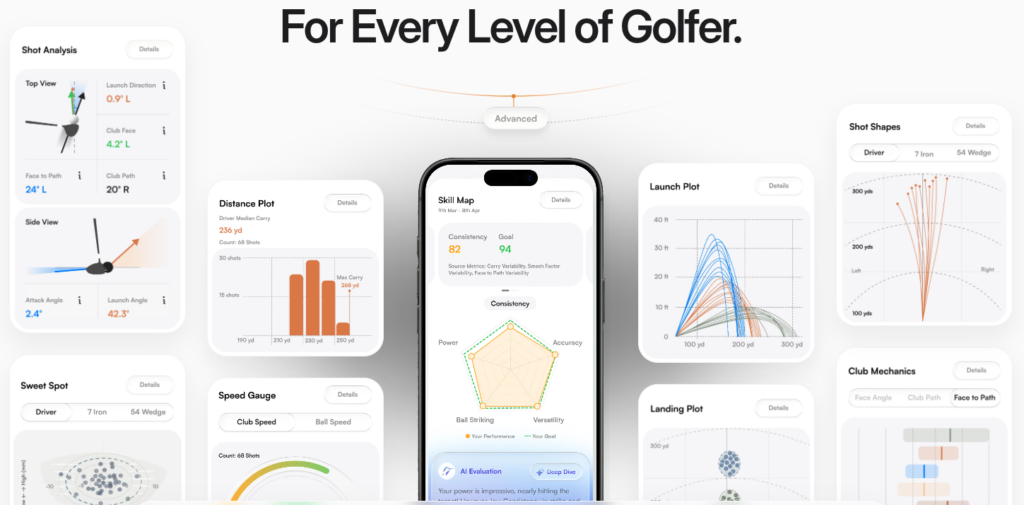
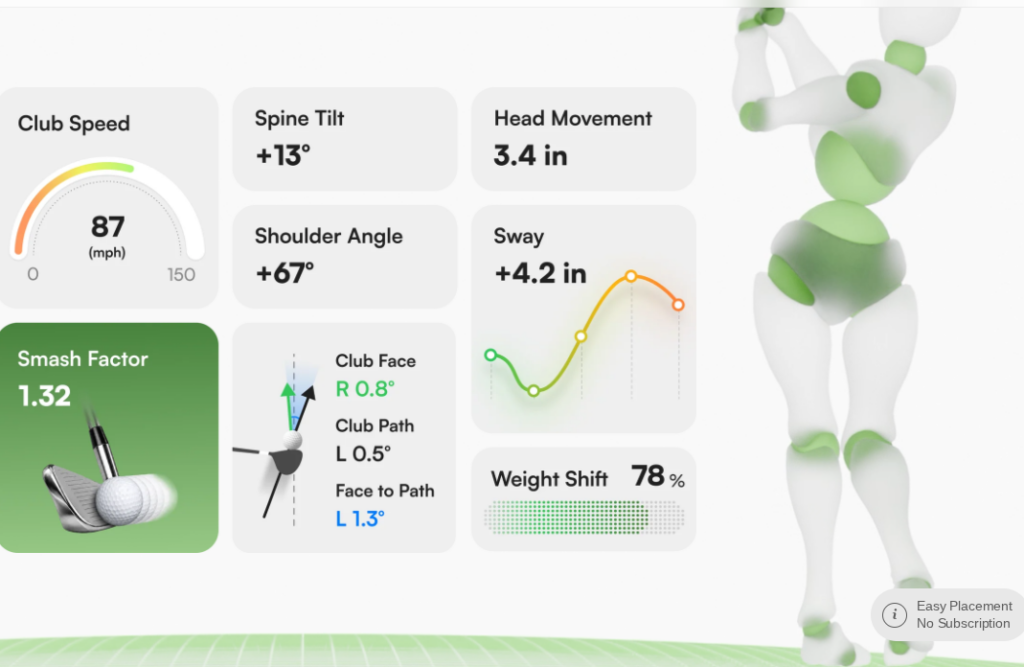
The system can collect ball data, club data and 3D body-motion information. From there, the AI can look at multiple swings rather than simply evaluating one isolated swing.
That matters because golfers aren’t robots.
One swing might be perfect. The next might be a shank. Another might be a pull. Looking at a single swing can make it difficult to separate an actual pattern from a one-off mistake.
Birdie Sense plans to collect a series of shots before producing its analysis, allowing the system to look for patterns and dispersion rather than simply reacting to whatever happened on the most recent swing.
How the Birdie Sense App Works
The Birdie Sense experience is built around a companion phone app, with both iOS and Android support planned.
The basic setup is fairly straightforward. The device sits behind the golfer while the phone is positioned in front, and the golfer hits shots while Birdie Sense collects the data.
Initially, that experience looks much like using a launch monitor.
You hit shots. You see your numbers. You continue practicing.
The difference comes after enough shots have been collected for the AI analysis.
Jack described the resulting experience as being somewhat similar to scrolling through an Instagram Story. Instead of presenting the golfer with a giant report full of technical information, Birdie Sense is designed to break the analysis into smaller pieces.
You’ll see video of your swing, selected frames, markings and explanations, with voice guidance helping walk you through the analysis.
The idea is to make the information easier to consume rather than simply giving golfers more data to sort through.
From there, the system can provide drills intended to address the issues it identifies.
That creates a loop that looks something like this:
Hit shots → collect data → identify patterns → understand the issue → work on a drill → hit more shots.
And because the system is designed to keep collecting information over time, that process doesn’t have to stop after one session.
Why Multiple Data Points Matter
One of the more interesting parts of the conversation was the discussion around existing swing-analysis technology.
There are already plenty of products that can tell golfers something about their swing.
For example, a golfer might use a wrist sensor to understand wrist angles or a camera-based app to look at body positions.
Those tools can be useful, but they can also leave pieces of the puzzle missing.
You might improve one measurement while unknowingly creating another problem elsewhere in the swing.
That’s where Birdie Sense is attempting to take a different approach.
Instead of looking at one isolated component, it wants to see the relationship between the golfer, the club and the ball.
Jack’s argument is pretty straightforward: the ball ultimately tells you whether the movement you’re making is producing the result you want.
That doesn’t mean the system is trying to force every golfer into the same swing.
In fact, Jack specifically talked about the difference between professional athletes and the majority of golfers who will actually use a product like this.
Most golfers aren’t trying to build a textbook swing.
They’re trying to hit the ball better.
AI Is a Big Part of the Equation
The other major piece of Birdie Sense is the artificial intelligence behind the analysis.
Jack explained that the project began before AI systems had reached their current capabilities. Early experiments with AI-generated swing analysis were often far too simplistic, producing generic recommendations regardless of what the golfer was actually doing.
That became one of the reasons the team realized it needed more information.
If the AI doesn’t know the club path, attack angle, ball flight or other relevant measurements, it has gaps in the information it needs to provide useful feedback.
The development of Birdie Sense therefore became less about simply adding AI to a golf product and more about figuring out what information the AI actually needed.
As the technology improved, so did the potential for the analysis.
That’s an interesting part of this product because the hardware isn’t necessarily the entire story. The AI systems being used to interpret the data are also changing rapidly.
What Birdie Sense can analyze today may not be the limit of what the platform can eventually do.
The Birdie Sense Hardware
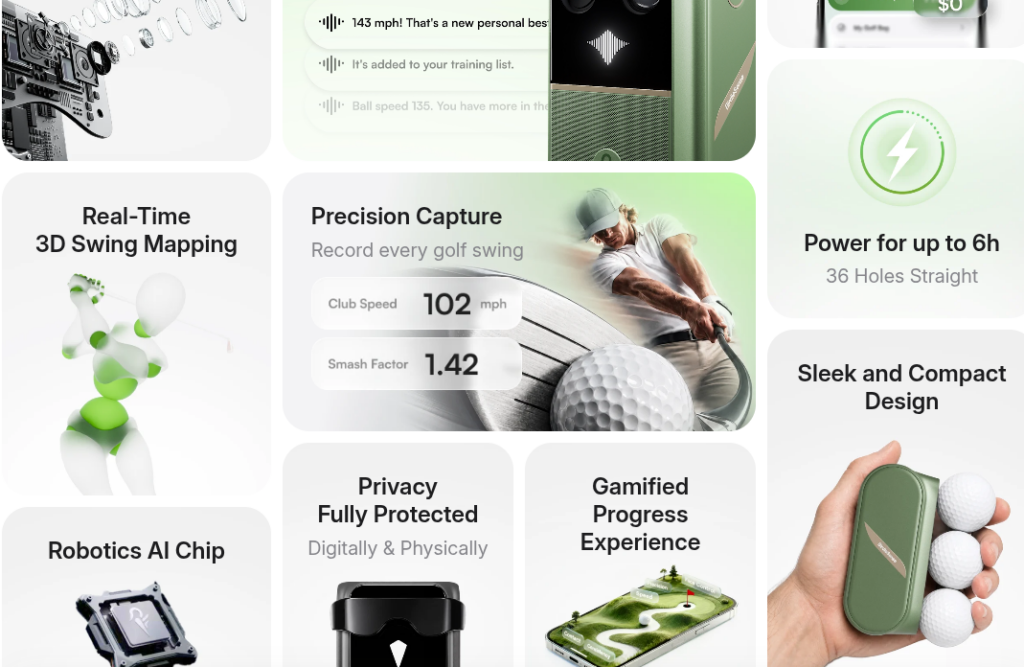
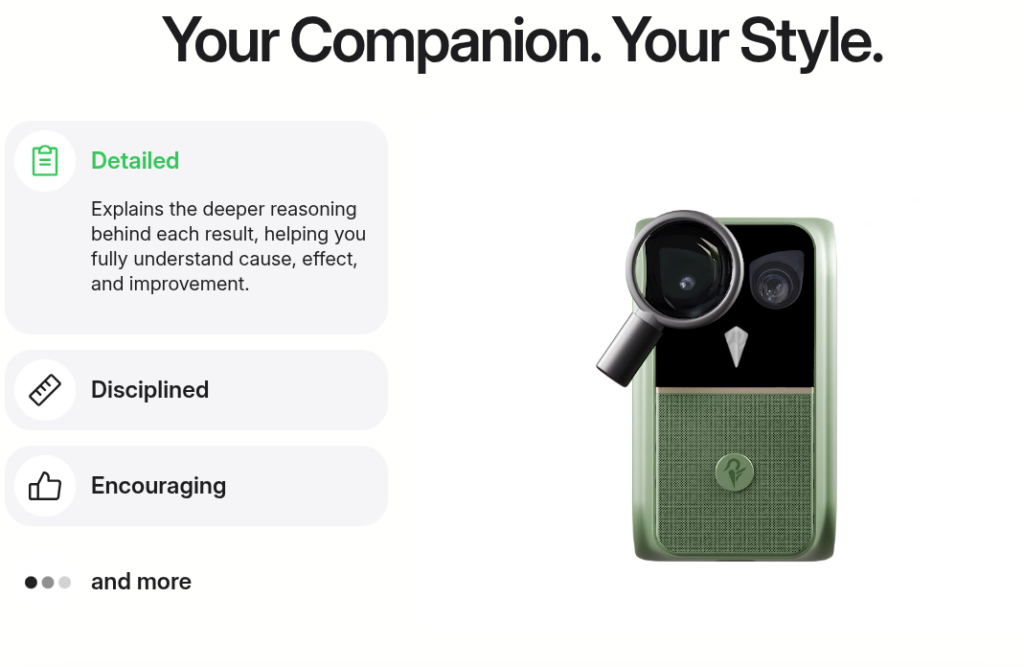
The device itself has a fairly distinctive appearance.
It looks like a small bird, which fits the Birdie Sense name, but Jack explained that some of the unusual design elements actually came from engineering requirements.
There are two cameras inside the unit, with each facing a different direction. Their positioning and field of view dictated much of the external shape.
Even the circular and angular elements around the cameras have functional reasons behind them.
There is a small screen on the front that displays basic information, while the device itself has just one physical button. Most of the interaction happens through the phone app.
The lower portion of the device also houses the cooling system. Because Birdie Sense is intended to operate for extended periods at the driving range, including in hot and sunny environments, the team designed a substantial cooling system into the unit.
The fan, microphone and speaker are integrated into the same area.
Jack also explained that the system is designed so the fan noise doesn’t overwhelm the audio captured in the swing videos.
That might sound like a small detail, but it speaks to the broader philosophy of the product. Birdie Sense isn’t being designed purely as a collection of sensors. The company is thinking about what the actual experience of using the device at the range will be like.
A Small Device With a Bigger Ambition
One thing that becomes apparent during the conversation is that the current Birdie Sense device is only part of the company’s larger vision.
The initial product is focused heavily on practice and analysis, but the company also wants Birdie Sense to eventually go onto the golf course.
That’s where things get particularly interesting.
Jack showed us an early version of the system’s on-course mounting solution. Rather than requiring the golfer to constantly hold or manually adjust the device, the mount is designed to attach to a golf bag and keep the Birdie Sense positioned correctly regardless of the terrain.
The mount uses its own center-of-gravity and balance design rather than requiring additional electronics to maintain its position.
The long-term goal is to have Birdie Sense track shots during an actual round.
That could eventually mean knowing where shots went, automatically keeping score, tracking yardages and generating a highlight video at the end of the round.
Some of those features depend on additional development and external mapping services, so they aren’t all part of the immediate experience.
But they’re clearly part of where the company wants the platform to go.
Left-Handed Golfers Will Have to Wait
There is one important limitation for the initial hardware.
Birdie Sense is initially designed for right-handed golfers.
Because of the way the cameras are positioned and the limited field of view required to balance image quality and distortion, the same hardware configuration can’t simply be used for both sides of the ball.
Jack said the company expects to create a left-handed version by essentially flipping the internal hardware configuration, but that won’t be available with the initial batch.
For a company trying to get a new hardware product into production, that’s understandable, but it’s worth knowing for left-handed golfers considering the device.
Subscription Model and Kickstarter
Birdie Sense is launching through Kickstarter, and one of the more interesting aspects of the initial campaign is how the subscription model is being handled.
For Kickstarter backers, the features being offered with the initial product are intended to be subscription-free.
Some of the more advanced features planned for the future may require a subscription for general customers, particularly features that rely on ongoing server and AI processing or external services.
However, Jack emphasized that the core metrics generated directly by the device won’t be locked behind a subscription simply because someone owns the hardware.
That’s an important distinction in a golf technology market where subscriptions have become increasingly common.
The Kickstarter campaign is also being used to determine the initial production volume. Rather than manufacturing thousands of units before knowing how many customers actually want the product, the campaign gives Birdie Sense a way to establish demand before moving into full production.
Jack said the expected timeline is roughly 45 days for the campaign, followed by approximately two to three months of production and additional shipping time.
The company’s goal is to get the first units into customers’ hands early in the following year.
Two Years of Development
Birdie Sense didn’t come together overnight.
Jack said the project had been in development for more than two years when we spoke.
Interestingly, the first year wasn’t primarily spent building hardware.
A significant amount of time was spent talking to golfers, visiting driving ranges and trying to understand what people actually wanted from golf technology.
Jack was based in Philadelphia during part of that process and spent considerable time at a local range talking to golfers and testing ideas.
That process eventually led to an important realization: simply analyzing the body wasn’t enough.
Without knowing what the club and ball were doing, the AI didn’t have enough information to provide the kind of useful feedback the team wanted.
That realization pushed the project toward its current camera-based system.
There were earlier prototypes, including a much larger box that was essentially an engineering prototype rather than a finished consumer product. The hardware eventually became smaller and more refined as the team worked toward components that could actually be manufactured at scale.
The current design began to settle into place earlier this year, although Jack was clear that development doesn’t stop simply because the product is approaching launch.
Where Birdie Sense Fits
There are already a lot of options for golfers who want technology to help them improve.
There are launch monitors.
There are swing cameras.
There are sensors.
There are coaching platforms.
There are apps.
Birdie Sense is attempting to sit somewhere in the middle of all of those categories.
That could ultimately be its biggest strength—or its biggest challenge.
The company isn’t trying to win simply by being another launch monitor with a few extra numbers. It’s trying to create an ecosystem where the launch data, swing data, AI analysis and eventually on-course experience all work together.
That’s a much bigger ambition.
It also means the quality of the overall experience will depend on more than just how accurately the device measures a golf shot. The AI has to provide useful information. The app has to make that information understandable. The recommendations need to actually help golfers improve.
And, eventually, the on-course functionality needs to deliver on the promise of having an AI golf companion with you for an entire round.
Birdie Sense Is Still at the Beginning
Perhaps the most important thing to remember about Birdie Sense is that this is an early-stage product.
It’s launching through Kickstarter. The initial hardware hasn’t yet reached the broader customer base, and several of the more ambitious features are still being developed.
That’s not necessarily a negative.
In fact, it’s part of what makes following something like Birdie Sense interesting.
The company has built a platform around the idea that hardware can continue to get smarter through software and over-the-air updates. As more golfers use the system, there’s also the potential for the analysis and overall experience to continue evolving.
Jack was very open about the fact that the product will continue to improve.
That mindset probably matters more here than it would with a traditional golf club or rangefinder. A device like this isn’t necessarily finished the day it leaves the factory.
The hardware provides the foundation. The software, AI and ecosystem can continue to change around it.
For golfers who are interested in where golf technology is heading, that’s probably the most compelling part of Birdie Sense.
It’s trying to move the conversation away from simply collecting more numbers and toward actually understanding what those numbers mean.
And if the company can successfully connect the ball, the club, the body and eventually the entire round of golf into one experience, Birdie Sense could occupy a pretty unique spot in the golf technology landscape.
For now, though, we’re interested to see what happens when those first units get into golfers’ hands.
Birdie Sense is currently launching through Kickstarter. The company is using its initial campaign to bring the first production units to backers while continuing development of the broader platform.
This article is based on our Life At The Turn Live conversation with Birdie Sense founding engineer Jack Lin.